Wolf Cooktop Repair for Gas, Induction and Electric Surfaces
Wolf builds cooktops on three different technologies, and each one breaks in its own way. A gas cooktop fails at the spark, the valve or the burner ports. An induction cooktop fails in its electronics — coils, power boards, sensors and cooling. A radiant electric top fails at its elements and switches. Our technicians start the diagnosis from a different place for each, which is why the first thing we ask is simple: what kind of cooktop do you have? We cover 2- to 6-burner gas models, 24-inch and 36-inch induction, electric and transitional units in the Professional and Contemporary styles.
Gas, induction and electric cooktops
Call, 24/7(872) 239-3565Why won't my Wolf induction cooktop detect my pan?
The zone needs a ferrous, flat-bottomed pan centered over its ring before it will switch on. Hold any small magnet to the base — if it slides off, the pan is the problem. A warped or undersized base can also be ignored. If proper pans are ignored on one zone, the coil or its power board is suspect; if every zone ignores them, look at power supply and controls.
How gas and induction cooktops fail
Choosing between the two belongs in our article on induction versus gas. Below we only map how each one breaks and where the inspection begins.
Gas cooktop
- Problems are mostly mechanical and visible: clicking without ignition, lazy or yellow flames, a burner that won't simmer low
- Spills, grease and moisture are the main enemies of igniters and ports
- Dual-stacked burners have an upper and lower flame path, and either can clog independently
- Testing means checking spark, flame shape, gas pressure and the valve behind each knob
Induction cooktop
- Problems are electronic: a zone that blinks, ignores the pan, shuts off or throws a code
- Heat and dust are the enemies — the cooling fan and air intake keep the boards alive
- Boost, bridge zones and pan detection all depend on coils, sensors and power modules working together
- Testing means reading codes, checking coils and boards, and confirming the cooling path is clear
Radiant electric tops sit in between: a dead zone is usually the element itself or the switch feeding it. Whatever the type, describing the exact behavior over the phone lets us bring the parts most likely to be needed.
Signs, and what usually causes them
- Gas burner clicks, no flame
- Wet or dirty igniter, cap sitting crooked, blocked ports, or a weak spark module
- Flame is yellow, tall, noisy or lifts off the burner
- Misaligned cap, debris in the ports or air shutter, or a gas pressure problem — needs checking
- Simmer flame goes out at the lowest setting
- The lower ring of a dual-stacked burner is clogged, or the valve needs adjusting
- Induction zone blinks or shows a code with the pan on it
- Unsuitable pan, coil or sensor fault, or the power board for that zone
- Induction shuts down after a few minutes of cooking
- Cooling fan failing or air intake blocked under the counter, so the electronics overheat
- Electric element stays cold or only glows at full power
- Failed element or the infinite switch behind the knob
- Knob spins loose or won't hold its setting
- Worn knob, stem or valve/switch shaft
- Burner trouble on a full range rather than a cooktop
- Same gas parts, but the oven may be involved Read more: ranges
What does a yellow flame on a Wolf gas cooktop mean?
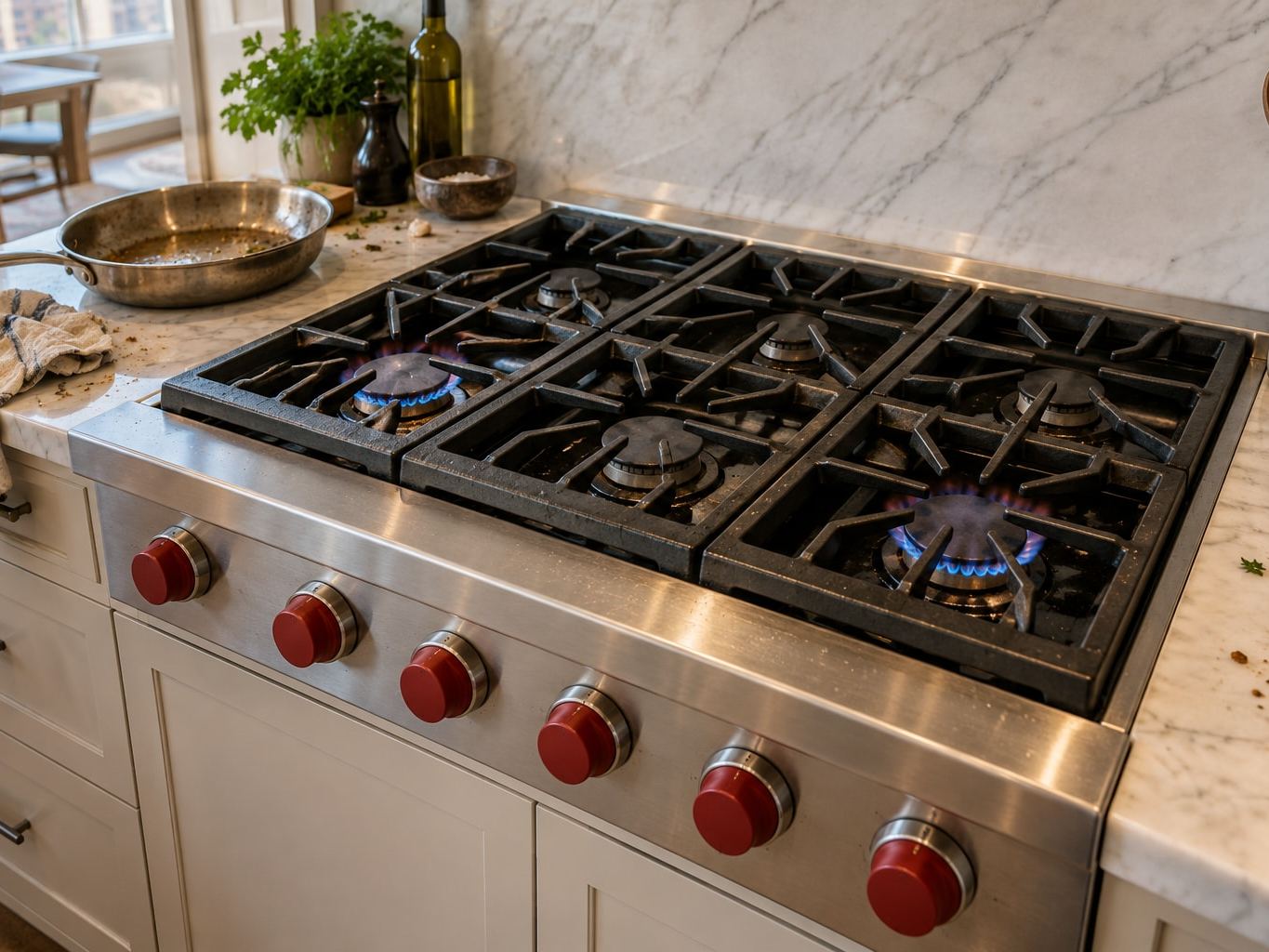
A healthy Wolf flame is crisp and blue. Yellow, floppy flames usually mean the burner cap is not seated, the ports are partly blocked by food or cleaner residue, or the burner is not getting the right air-to-gas mix. Clean and reseat the cap; if the flame stays yellow or leaves soot on pans, book an inspection.
Gas safety
When to stop cooking right now
If you notice a gas smell, do nothing at the cooktop: do not turn knobs, do not flip switches, and do not open windows. Get every person and pet out of the unit, walk well away from the door, and phone the gas company or 911 from there. We come in after the responders give the all-clear.
- Gas odor or a hissing sound with burners off: leave, then call from outside
- Cracked glass on an induction or electric top: stop using it, keep liquids away from the crack, and cut power at the breaker panel
- Burner flames reaching past the grate or blackening pans: stop using that burner until it is checked
What the technician does at your cooktop
Identify the model
The model and serial plate is read so the right parts list, glass and board references are on hand.
Reproduce the problem
Each burner or zone is run at high and low settings, including Boost, simmer and bridge modes where the model has them.
Look underneath
On gas models that means igniters, wiring, ports and valve operation. On induction it means coils, boards, sensors, the cooling fan and the intake path under the counter.
Check the safety features
Hot-surface indicators, automatic shut-off and, on gas, steady re-ignition all have to work before we sign off.
Quote, repair, retest
You get a price before any work starts. Once finished, we fire up each burner or zone a second time while you look on.
What affects the cost of a cooktop repair
The $89 service call comes off the bill when you go ahead with a repair. The repair price itself is quoted after inspection and depends on:
- 01Technology
- Scrubbing and tuning a gas burner bears no resemblance, in labor or parts, to swapping an induction power board.
- 02The part
- Igniters, knobs and caps are smaller items; spark modules, valves, coils, boards and glass are larger ones.
- 03Glass replacement
- Wolf glass is specific to each model, so the replacement panel is sourced against your exact model number.
- 04Installation
- Cooktops set into stone counters or islands with downdraft ventilation can take more time to open up.
- 05Number of zones affected
- One burner and five burners are not the same job; each fault is priced so you can decide.
Can the glass on a Wolf cooktop be replaced?
Yes. The glass top on Wolf induction and electric cooktops can be replaced without replacing the whole appliance, but the panel is made for a specific model, so it has to be ordered once the technician confirms your model and checks that the coils and electronics underneath survived.
Cooktop questions we get on the phone
- My induction cooktop beeps and won't start — is it broken?
- Not necessarily. Many Wolf induction tops lock their controls or refuse to heat without a suitable pan. Check the control lock and try a magnetic pan. If it still beeps or shows a code, write the code down and call us.
- Do I need a different technician for gas and induction?
- No. We repair Wolf gas, induction and electric cooktops; the technician simply brings different test equipment and parts depending on which one you have.
- How often should Wolf gas burners be checked?
- An annual check suits most kitchens: burners cleaned, then ignition and flame shape inspected. Our guide to caring for cast-iron grates covers the part you can do yourself.
- Is it safe to use a cracked glass cooktop for one more meal?
- No. Spills can reach the electronics through the crack and the glass can break further under heat. Kill its circuit at the electrical panel and leave it alone until the glass is replaced.
- Can you also look at the hood above my cooktop?
- Yes. If the downdraft or hood isn't pulling smoke away, that is a separate ventilation repair we can handle on the same trip if you mention it when booking. The $89 visit fee is still charged once, and each repair gets its own price after inspection.
- What if my cooktop fails outside business hours?
- Our phones are covered 24/7 and we schedule technicians daily, 8:00 AM to 6:00 PM. If gas is what you smell, get outside before you make any call. The emergency page covers what to do while you wait.
- What will a cooktop repair set me back?
- We charge $89 to come out, and that sum is absorbed into the repair if you approve it. A firm figure for the fix follows the inspection; the pricing page walks through it.