Wolf Hoods and Downdrafts That Stopped Pulling Smoke
Nobody admires a range hood until the kitchen fills with smoke from a seared steak. This page covers the motor, the speeds and the automatic features of Wolf ventilation, including the ones that look like faults but are not, plus what we fix when something really has failed. Call 24/7 at (872) 239-3565 or book a visit.
Wall, island and under-cabinet hoods · Downdrafts
Call, 24/7(872) 239-3565The appliance you only notice when it quits
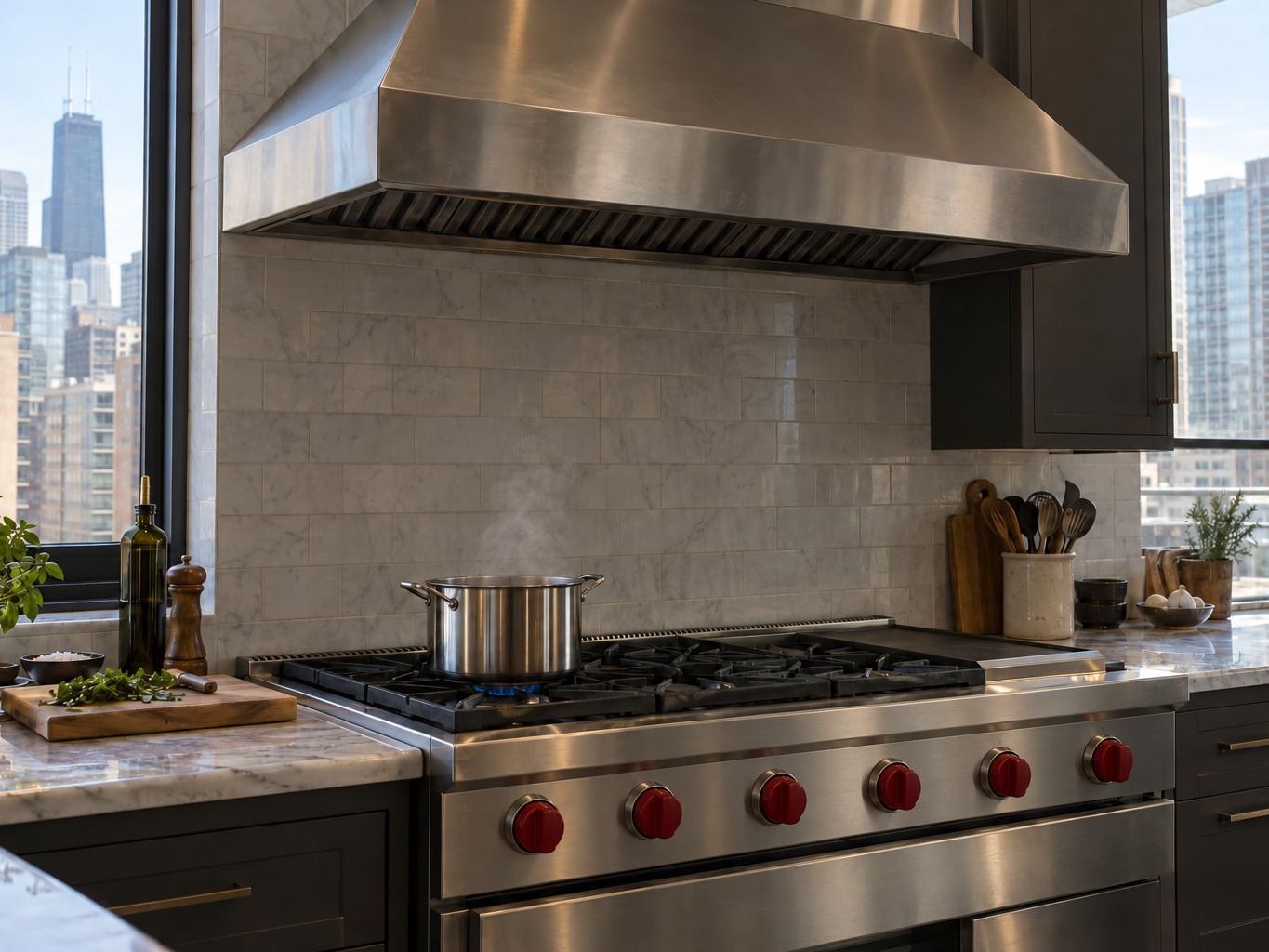
A Wolf hood works every time a burner is lit, yet it is usually the last appliance anyone thinks about. Wolf builds ventilation in several forms: pro wall hoods, island and ceiling-mounted hoods, under-cabinet hoods, inserts that disappear inside a custom hood cover, and downdrafts that rise behind a cooktop and drop out of sight when you are done. Most offer variable fan speeds, and some use perimeter aspiration, drawing air through a narrow gap around the edge of the hood for stronger capture.
The blower that does the work is not always inside the hood. It can be internal, mounted in-line somewhere along the duct, or remote on an outside wall or the roof. That matters for diagnosis: a hood whose lights glow but whose fan stays silent may have a perfectly good switch and a dead connection far away. Our technician follows the airflow and the wiring from the controls to wherever the motor actually sits.
Because the hood serves the burners below it, we often check them together. If the trouble started after a cooktop or range repair, or your burners themselves are acting up, see Wolf range repair and cooktop and rangetop repair. For why ducting outdoors matters and how recirculating kits differ, read why Wolf ventilation matters.
Signs the hood needs a technician
Each sign points to a different layer of the system, from filters to motor to controls.
- The fan stays silent, though the lights may work
- Blower motor, its thermal protector, the speed control or a loose connection at a remote blower
- Fan runs, but smoke rolls past the hood
- Grease-loaded baffles, a damper stuck closed, a crushed duct or a motor losing speed
- Rattling, humming or vibration at higher speeds
- Loose housing or duct joint, an unbalanced blower wheel, or worn bearings
- Lights dim, flicker or stay dark
- Lamps, the light driver or transformer, or the switch
- Stuck on one speed, or ignores the buttons
- Control board, switch assembly or wiring to the blower
- Downdraft will not rise, stalls or rises crooked
- Lift motor, guide tracks, position switches or the control Read more: cooktops & rangetops
Why won't the fan on my Wolf hood turn on?
Check the simple things first: a tripped breaker, controls left off or locked, and filters seated properly. If the lights work but the fan does not, the usual culprits are the blower motor, its thermal protector, the speed control, or a loose connection at an in-line or remote blower. Those parts sit behind the housing and need a technician.
Filter check before you book
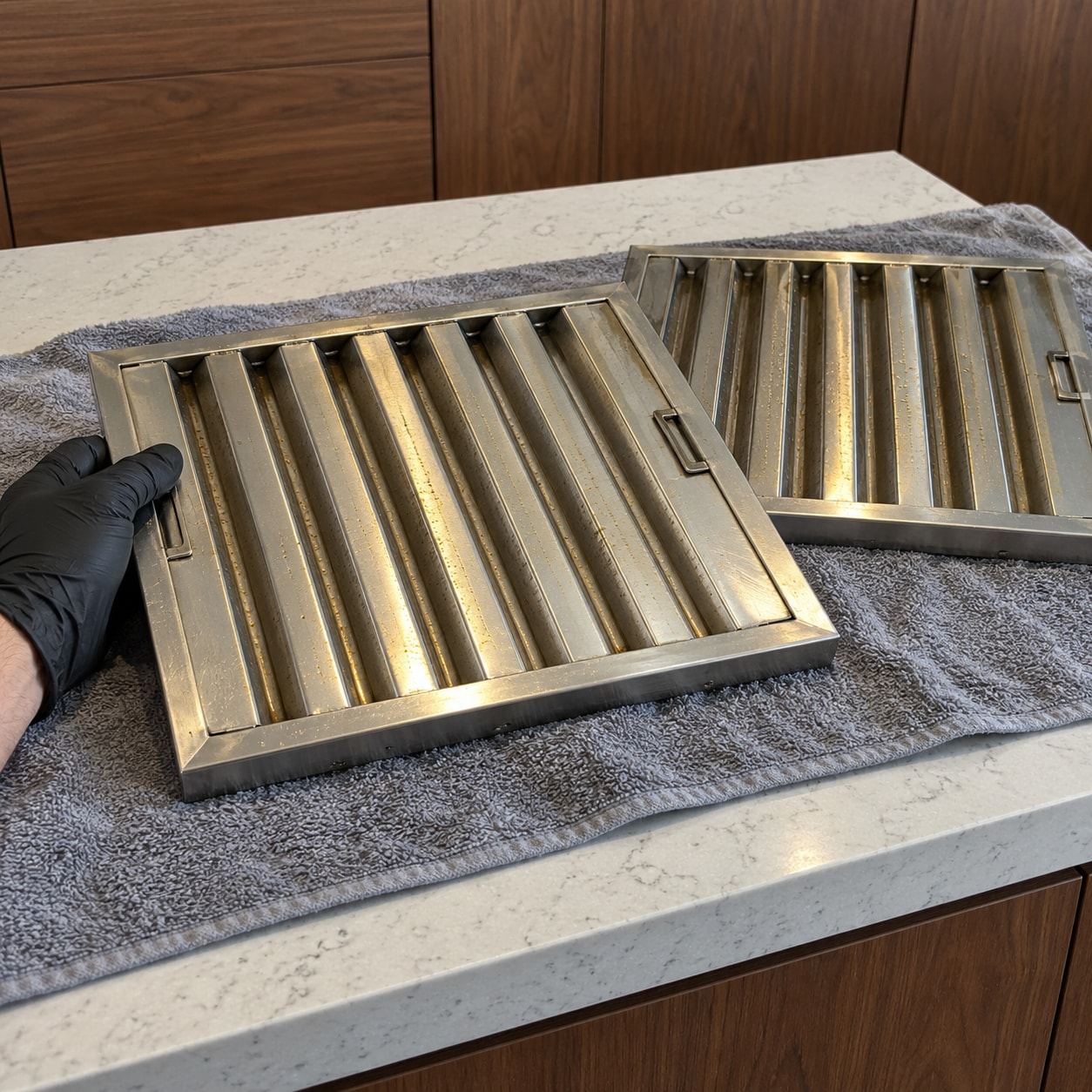
Clogged filters are a frequent cause of weak draw, more often a cleaning job than a failed part. Five minutes here can save a visit.
- Pull the stainless baffle filters and look along the channels. If grease has bridged the gaps, wash them; every one to three months is a sensible rhythm, and they can go in the dishwasher.
- If you have a recirculating kit, its charcoal filters are replaced, not washed, roughly every six to twelve months, and sooner with frequent frying.
- Reseat every filter fully. One sitting crooked leaves a gap that lets grease reach the blower and the duct.
- Note whether the trouble is airflow, noise, lighting or controls, and which speeds are affected.
- Look for the model and serial label, often visible inside the hood once the filters are out.
- In a tower, ask the management office or concierge how service visits are approved and whether the freight elevator must be reserved.
Hood styles and where they tend to fail
The shape of the hood decides where its weak points are and how much work it takes to reach them.
| Type | Where it sits | What tends to fail |
|---|---|---|
| Pro wall hood | On the wall above a range or rangetop | Blower bearings, speed switch, lamps, overloaded baffles |
| Island or ceiling hood | Suspended over an island cooktop | Weak draw on long duct runs, vibration at the mount, lighting |
| Under-cabinet hood | Beneath a run of wall cabinets | Controls and lamps close to the heat, filter seating |
| Ventilation insert | Hidden inside a custom hood cover | Blower and controls tucked into the millwork, reached from below |
| Downdraft | Rises behind a cooktop on an island or counter | Lift motor, guide tracks, position switches, blower under the counter |
Why is my Wolf downdraft stuck in the counter?
A downdraft that will not rise usually has a lift motor, guide track or position switch problem, or something resting on the vent or jammed in the counter slot. Clear the top, check that the unit has power and try once more. If the motor strains or makes no sound at all, leave it down and book an inspection instead of pulling it up by hand.
Things that look broken but are not
- Heard it saidA hood that switches itself on is malfunctioning.
- What actually happensOn many Wolf hoods that is Heat Sentry at work. A heat sensor notices strong heat rising from the cooktop and starts the blower or raises its speed, and it keeps going until the area cools. It is a fault only if it happens with every burner cold.
- Heard it saidThe fan kept running after I pressed off, so the switch is bad.
- What actually happensDelayed shut-off lets the blower run for a short while after cooking to clear the last smoke and moisture, then stops on its own. If it never stops, that is worth a call.
- Heard it saidWeak suction means the motor is dying.
- What actually happensMost weak-draw complaints trace back to greasy baffles, a backdraft damper that no longer opens fully, or a duct that was crushed or kinked during renovation work. The motor is checked last, not first.
- Heard it saidA louder hood pulls more air.
- What actually happensNoise that grows over time usually means a grease-coated wheel out of balance or bearings wearing out. Both cut airflow while making the hood sound busier.
Before you touch it
Filters are yours, the housing is ours
A hood hangs over a hot surface at the top of a reach, with household-voltage wiring and a blower that weighs more than it looks. Washing filters is owner work. Opening the housing is not.
- Let the cooktop cool before reaching up for the filters.
- Do not remove the blower, light housings or control panel, or work on the wiring yourself.
- Do not force a stuck downdraft up or down by hand: its lift gear and tracks bend easily.
What happens on a hood visit
Building and access
For high-rise kitchens we work within the building's rules: approval through management or the concierge, a reserved freight elevator where needed, and protective coverings along the route to your unit.
Run every speed
The technician runs the fan through each speed, listening for changes in pitch and watching how smoke or steam is captured at the edge of the hood.
Follow the air
Filters, damper and the reachable part of the duct are checked before any electrical part is condemned.
Trace power and controls
Power is followed from the controls to the motor, whether it sits in the hood, in the duct or outside the home, and the lights and their driver are tested on the same pass.
Price before parts
You get the cause and an exact price before anything is replaced. The $89 visit is credited toward the repair.
Prove the result
After the repair every speed, the lights, Heat Sentry where fitted, and delayed shut-off are run again, and a downdraft is cycled up and down several times.
What moves the price of a hood repair
Ventilation work has no fixed menu price; the exact figure comes after the inspection. These are the things that shape it. More detail on our pricing page.
- 01Where the blower lives
- An internal blower is reached from below; an in-line or remote one may sit in a soffit, on an outside wall or on the roof.
- 02Hood style and height
- Island hoods, tall ceilings and inserts hidden in millwork need more setup than a wall hood at normal height.
- 03Which part failed
- A lamp or a control is a different job from a motor, a blower wheel or a downdraft lift mechanism.
- 04Parts on hand or ordered
- Common parts may be on the truck; others have to be ordered, which can mean a second visit to install them.
- 05Building logistics
- Freight elevator booking, protective coverings and time windows set by management all add steps to the visit.
Why does my Wolf hood turn on by itself?
Usually that is Heat Sentry: a sensor in the hood starts the blower, or speeds it up, when it detects strong heat from the cooktop, and it keeps running until things cool. Delayed shut-off can also keep the fan going briefly after you switch it off. If the hood starts with the cooktop cold, the sensor or the controls need checking.
Hood and downdraft questions
- How often should I clean the baffle filters on my Wolf hood?
- Every one to three months suits most kitchens, closer to monthly if you sear, fry or cook in a wok often. Stainless baffles can go through the dishwasher; let them dry before refitting.
- Do charcoal filters need cleaning too?
- No. Charcoal filters in a recirculating kit cannot be washed back to life; they are replaced, roughly every six to twelve months depending on how much you cook.
- Can you repair a hood in a high-rise condo?
- Yes. Tell us the building when you book, and check with management whether the visit needs approval or a freight elevator reservation. Our service area page lists the neighborhoods we cover.
- Why has my hood gotten louder over the years?
- Gradual noise usually means wear: grease building up on the blower wheel and throwing it off balance, bearings starting to go, or a fastener that has worked loose. A sudden change in sound deserves a check before the motor stops altogether.
- My hood lights went out but the fan works. Is that a separate repair?
- Yes, and usually a smaller one. It can be the lamps themselves, the driver or transformer feeding them, or the switch. The technician tests the lighting circuit on its own.
- Should a stuck downdraft be pushed back down?
- No. Pressing or pulling it can bend the lift mechanism or knock it off its guide tracks. Leave it where it stopped, switch the cooktop off and call us 24/7 at (872) 239-3565.