When a Wolf Microwave Hums but Won't Heat, or the Drawer Won't Budge
A Wolf microwave is built into your cabinetry, so a drawer that refuses to move or an oven that hums without warming anything is harder to live with than a countertop box. Below: what you can check safely from the outside, the point where the job belongs to a technician, and how a visit runs in a Gold Coast, Streeterville or River North kitchen. Reach us 24/7 at (872) 239-3565 or book a visit online.
Drawer models · Built-in microwave ovens
Call, 24/7(872) 239-3565Why is my Wolf microwave drawer stuck shut?
Usually something is blocking the drawer, the control lock is on, or the drive has a fault. Make sure nothing is caught behind the drawer front, turn off the lock, and reset power at the breaker. If the motor whirs but the drawer stays shut, or nothing responds at all, the slides, drive or position sensing need a technician.
Before you touch it
Leave the outer case closed
Every microwave has a high-voltage capacitor that can hold a dangerous charge after the unit is unplugged or the breaker is off. The outside checks on this page are safe for an owner. Anything behind the trim or the metal case is a job for a technician, who discharges the circuit before touching a part.
- Do not loosen screws on the case, the back panel or the trim kit.
- Do not run the microwave empty to test it: with nothing to absorb the energy, the magnetron takes the strain.
- Stop using a unit that sparks, smells of hot plastic or trips the breaker, and keep it off until it has been inspected.
What the microwave is telling you
Match what you see to the likely cause. The right-hand column is a starting point for diagnosis, not a parts order.
- Light, fan and turntable all run, but food stays cold
- High-voltage side: magnetron, diode or capacitor, or a door switch cutting that circuit
- Turntable stays still on a door-style model
- Turntable motor, its coupler or the roller ring under the glass tray
- Drawer will not open, or stops partway
- Obstruction, worn slides, drive motor or gears, or a lost position signal
- Sparks or blue flashes inside the cavity
- Soiled or burned waveguide cover, chipped cavity coating, or metal left inside Read more: emergency repair
- Touch pad ignores presses or shows an error
- Control lock, worn membrane keys, a loose ribbon cable or the control board
- A new buzz, grinding sound or heavy hum
- Cooling fan blade, turntable motor, or a magnetron working under strain
Drawer or built-in: two different machines
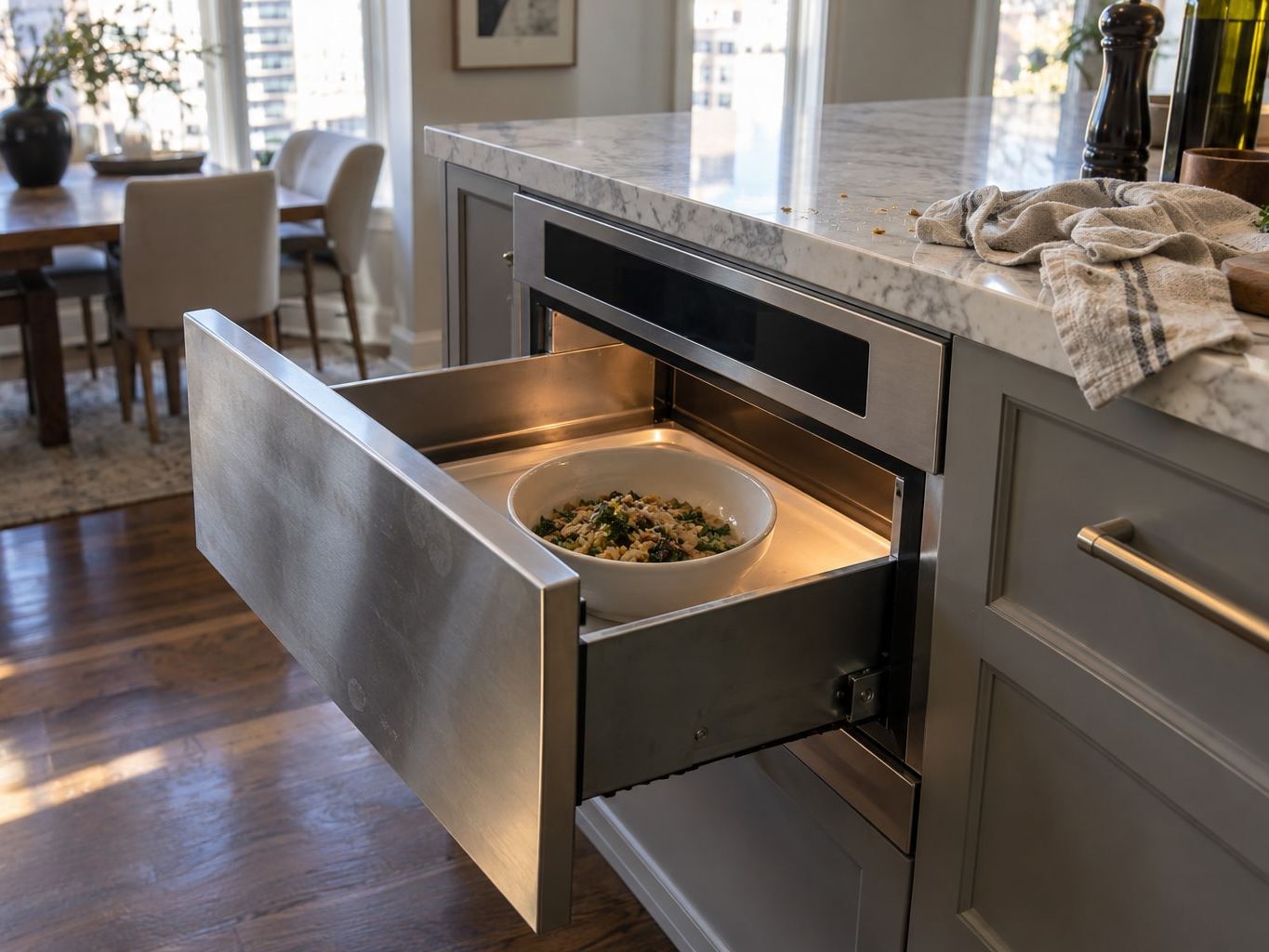
Wolf microwaves come in two broad layouts, and they break in different places. The drawer model slides out from below a counter or an island and opens at a touch, without a handle. That convenience adds a motor, a gear set, a pair of slides and sensors that report whether the drawer is fully open or fully closed. When the cooking works and the drawer does not, the fault is almost always in that mechanical layer, not in the heating side.
The built-in oven sits higher, usually in a wall of cabinets or above a wall oven, and opens with a door. It has a turntable and, on some models, a convection fan and element so it can brown and crisp like a compact oven. Its weak points are the door latch switches, the turntable drive and, on convection versions, the fan, the element and the logic that hands over between microwave energy and convection heat.
Both share the same heating core and many of the same habits: sensor cooking that reads the steam rising from food, quick-start presets and a keep-warm setting. When sensor programs begin finishing early or running long, the humidity sensor and the vent path around it come first on the list. If your unit is a speed oven or a combination oven rather than a standalone microwave, go to Wolf oven repair; steam models have their own page under steam oven repair.
Why does my Wolf microwave spin while the food stays cold?
When the light, fan and turntable work but food stays cold, the high-voltage circuit that makes microwave energy has failed, most often the magnetron, the diode or the capacitor. A faulty door switch can also block that circuit. These parts sit behind the case and can hold a charge, so they are tested by a technician after discharge.
Which part, which symptom
These are the components a technician measures on a Wolf microwave, with the way each one usually shows up when it fails.
| Component | What it does | How a fault shows up |
|---|---|---|
| Magnetron | Produces the microwave energy that heats food | Runs without heating; a deeper hum than usual |
| High-voltage diode | Feeds the magnetron with the right kind of current | No heat, sometimes a buzz followed by a tripped breaker |
| High-voltage capacitor | Stores charge for the magnetron circuit | No heat; always discharged before any test |
| Drawer drive and slides | Open and close the drawer on command | Drawer stalls, jerks, opens partway or not at all |
| Door latch switches | Cut power the moment the door opens | Won't start, starts on the second try, stops mid-cycle |
| Touch panel and control board | Read your input and run the programs | Dead keys, error messages, sensor programs misbehave |
| Turntable motor | Turns the tray on door-style models | Tray stays still, food heats in rings |
From the doorbell to a hot plate of food
From your first call to the final test, this is the order the work follows.
Describe it on the phone
Tell us whether you have a drawer or a door model and what happens when you press Start: does the light come on, does the fan run, does the drawer move? That tells the technician which parts to expect on the bench.
Protect the cabinetry
Built-in units are framed by a Wolf trim kit matched to the surrounding cabinets. The technician covers nearby surfaces and takes the trim off carefully, so it goes back without new gaps or marks.
Pull the unit and discharge it
The microwave is eased out of its opening, power is isolated and the high-voltage capacitor is discharged before anything inside is touched.
Test each suspect part
Magnetron, diode, capacitor, switches and drive motor are measured one at a time, so the quote names the real failure instead of a bundle of possible parts.
Agree on the price first
Nothing is replaced until you have heard what failed and what fixing it will cost. If you approve the work, the $89 call fee is deducted from it; here is how pricing works.
Reinstall and prove it
The unit goes back in, the trim is refitted, and the technician runs a heating test and, on drawers, repeated open-and-close cycles while you watch.
Stuck drawer: mechanical or electronic?
A drawer that won't open is a frequent drawer complaint. Two very different causes produce it, and the sound usually gives the answer away.
Mechanical cause
- The motor runs, but the drawer barely moves or stops partway
- Movement is jerky, or the drawer rubs and sits crooked in its opening
- A utensil fell behind it, or the cabinet front was recently adjusted
- Usual repair: clearing the obstruction, new slides, gear set or drive motor
Electronic cause
- Pressing Open does nothing: no motor sound, no movement
- The display lights up but ignores the open command or shows an error
- It opens after a breaker reset, then fails again within days
- Usual repair: lock settings, position sensors, wiring or the control board
Never pry a powered drawer open by hand. Forcing it can strip the gears and turn a sensor fix into a mechanical repair as well.
Is it safe to fix a microwave yourself?
Only the outside checks are safe for an owner: turning off the control lock, resetting the breaker, clearing anything that blocks the drawer and cleaning the cavity. Opening the case is not, because the high-voltage capacitor can hold a lethal charge even with the microwave unplugged. Internal testing and part replacement belong to a trained technician.
Microwave questions owners ask
- Can you refit the trim kit after taking the microwave out?
- Yes. Wolf built-in microwaves are framed by trim kits made to sit flush with the cabinets, and removing and refitting that trim is part of the job. Mention it when you book if the trim was customized or the cabinets were refinished, so the technician plans for it.
- Is it worth repairing a Wolf microwave drawer instead of replacing it?
- Get a diagnosis before you decide. A drawer is sized to its cabinet opening, so a replacement has to match that opening and the trim, while many drawer faults come down to slides, a drive or a sensor. Once the cause is known you get the exact price and can choose; the $89 call is credited to the repair.
- What should I do if my microwave sparks?
- Stop the cycle and look for metal: foil, a twist tie, a plate with a gold or silver rim. If there was none, do not run it again, because repeated arcing burns the waveguide cover and the cavity coating. Call us 24/7 at (872) 239-3565; if it also smells of burning or trips the breaker, read our urgent repair page.