Wolf Oven Repair Starts With the Controls, Not the Element
When a Wolf built-in oven stops behaving, people assume a heating element has burned out. Sometimes it has. Far more often, the oven is perfectly able to make heat and is simply being told the wrong thing — by a sensor, a relay, a fan that has stalled or a touch interface that has lost its mind. We repair Wolf wall ovens across the Gold Coast and the surrounding Near North neighborhoods, and the first job on every visit is figuring out which part of that chain has broken.
Built-in ovens: single, double, 24 and 30 inch
Call, 24/7(872) 239-3565One cabinet, several systems
A modern Wolf oven is closer to a small control network than to a hot box. The touch panel or knob takes your request; a control board decides how much power each element gets; a temperature sensor inside the cavity reports back several times a minute; one or more convection fans move the air; and a door lock and gasket keep the whole thing sealed, especially during self-clean. A failure anywhere in that loop shows up as the same complaint: "it's not cooking right."
We work on the current M Series and E Series lines as well as earlier Wolf built-ins: 24-inch and 30-inch cavities, single and double ovens, and the combination units that pair an oven with a microwave or speed oven above it. Doubles are worth a mention because the two cavities often share a control board while keeping their own sensors and fans — so one dead cavity and one healthy cavity is a strong clue, not a coincidence.
Because so much depends on the controls, a good diagnosis usually saves money. Replacing the right sensor costs far less than replacing parts until the symptom goes away.
Why does my Wolf oven turn on but stay cold?
A lit screen over a cold cavity usually means the oven is asking for heat and not getting it: a burned-out bake or convection element, a relay on the control board that never closes, a tripped thermal cutoff, or a door lock stuck from self-clean. A dark display points to power, a fuse or the board itself. Testing under load tells which.
Common wall oven symptoms
Write down the exact behavior before you call. "Shows 350 but the food is pale" and "won't start at all" lead to very different parts.
- Oven turns on, display counts up, but nothing gets hot
- Element, element relay on the board, or a thermal cutoff that has opened
- Temperature on the screen and real temperature disagree
- Temperature sensor drifting, a loose sensor connection or heat escaping through the door seal Read more: signs an oven needs service
- Convection mode is quiet, or the fan rattles and squeals
- Convection fan motor, fan blade rubbing the cover, or the motor's control circuit
- Self-clean won't start, or the door stays locked after it ends
- Door lock motor or switch, lock sensing, or a control fault
- Door drops open, won't close square, or the seal looks crushed
- Worn hinges or a hardened, torn gasket
- Touchscreen frozen, beeping, or showing an error code
- User interface board, communication between boards, or a sensor fault the screen is reporting
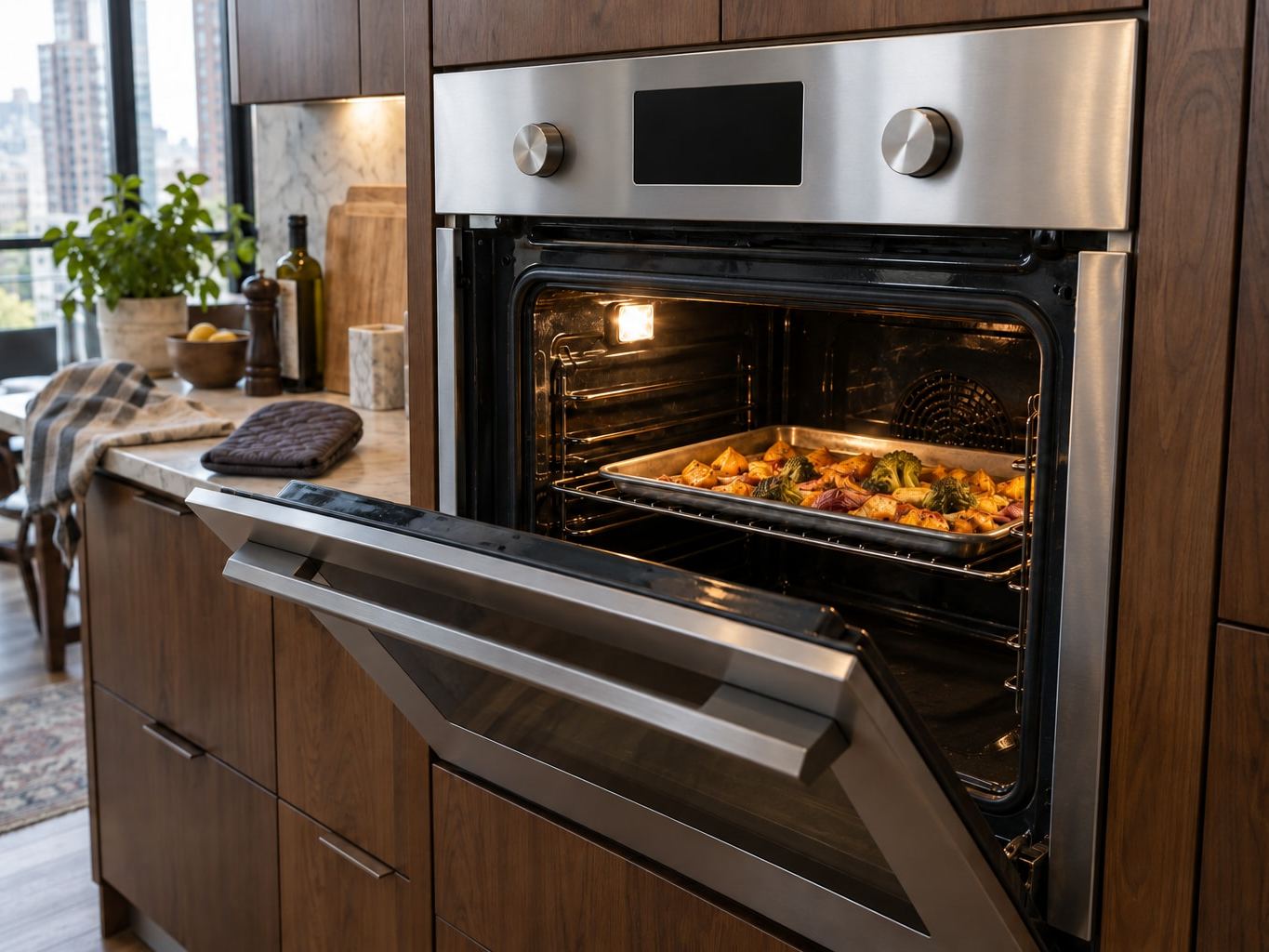
Before you pick up the phone
Five minutes of preparation lets us arrive with the right expectations and, when possible, the right parts.
- Model and serial number from the rating plate; on a wall oven, open the door and check the frame
- The exact error code or message, photographed if it comes and goes
- Which mode the problem shows up in: bake, convection, broil, a Gourmet program, self-clean, or all of them
- Whether it is the upper or lower cavity on a double oven
- Anything that happened right before: a power outage, a self-clean cycle, a spill on the panel
- Building access notes: doorman, service elevator, parking for the technician
What does an error code on a Wolf M Series touchscreen mean?
The code identifies which circuit the oven thinks has failed — a sensor, the door lock, a fan or communication between boards. It narrows the search but is not a verdict: a faulty sensor can make a healthy board throw an error. Note the code, switch the breaker off and on once, and book a diagnosis if it returns.
Which part each cooking mode depends on
If only one mode misbehaves, that tells us a lot. This table connects the Wolf modes to the components they lean on hardest.
| Mode | What it does | Parts we check first when it fails |
|---|---|---|
| Dual VertiCross convection | Two fan systems move heated air through the cavity for even multi-rack cooking | Both convection fans and their motors, convection elements, fan control on the board |
| Gourmet mode | Preset programs that pick mode, temperature and timing for you | Interface board and software; the underlying element or fan the program calls for |
| Temperature probe | Cooks to an internal food temperature instead of a timer | Probe itself, the probe jack inside the cavity, wiring to the board |
| Dehydrate | Low heat with steady airflow to dry food | Convection fan and low-temperature sensor accuracy |
| Stone | Strong bottom heat for a baking stone | Bake element and its relay, lower-cavity sensor readings |
| Self-clean | Very high heat with the door locked | Door lock, gasket, thermal cutoffs, cooling fan |
Before you touch it
Skip self-clean until the door is fixed
Self-clean pushes the cavity far hotter than any recipe. If the door lock is acting up, the gasket is torn, or the door doesn't close square, do not run the cycle: heat can escape into the cabinetry and controls, and a lock that fails mid-cycle can leave the door stuck shut. Clean the cavity by hand for now and get the door looked at.
- Torn, flattened or missing gasket sections
- Lock that clicks repeatedly or shows a lock error
- Door that sits crooked or springs open
Two assumptions that cost owners money
- Heard it saidAn error on the touchscreen means the whole control system has to be replaced.
- What actually happensWolf ovens split the controls into separate pieces. Very often the fault sits in the user interface board alone, and replacing just that board brings the oven back without touching the rest of the electronics.
- Heard it saidIf it heats at all, the element is fine and the oven is just old.
- What actually happensA sensor that reads low makes the oven overshoot; one that reads high leaves food underdone. The element can be perfect while the readings are wrong. Our guide to convection cooking helps separate technique from a real fault.
How the repair price is worked out
Each appointment opens with a $89 call-out charge. That buys the trip, the testing and a plain-language explanation with a quote; it comes off the final bill when you approve the work, and it remains payable if you choose to stop there. The repair price itself is set after inspection, based on:
- 01Electronics or hardware
- Interface and control boards, sensors and relays are priced differently from hinges, gaskets and elements.
- 02Single, double or combination unit
- Doubles and oven-microwave combinations often have to come out of the cabinet to reach the part.
- 03Series and age
- M Series, E Series and older built-ins use different parts; some legacy parts take longer to source.
- 04One fault or several
- A failed fan and a worn gasket can be handled in one visit, each priced separately so you choose.
Why is the convection fan in my Wolf oven not working?
A silent fan usually means a failed motor, a broken connection, or the control board no longer sending power to it. Grinding or squealing comes from worn motor bearings or a blade touching its cover. Either way, convection modes will cook unevenly, so stick to plain bake until the fan is replaced.
Six stages between the phone call and dinner
Phone call
We take the model, the symptom and any code, and book a visit inside our daily, 8:00 AM to 6:00 PM window. Someone picks up the phone 24/7.
Arrival
The technician protects the floor and nearby cabinetry and confirms the problem with you.
Diagnosis
Elements, fans, sensors, lock and boards are tested in the modes where the fault appears.
Explanation
You hear what failed and why, plus the exact price to fix it.
Your decision
Nothing is repaired until you say yes.
Repair or parts order
If the part is on hand, the repair happens and the oven is tested; if it has to be ordered, we book a return visit to install it.
Wolf oven questions
- Do you repair Wolf steam ovens and microwaves too?
- Yes, but they have their own pages because the problems are different: water and scale in a steam oven, magnetrons and door switches in a microwave or speed oven.
- Can I use the other cavity of my double oven while one is broken?
- Often yes, if the healthy cavity heats normally and there is no burning smell or tripped breaker. Because both may share a board, mention it when you book so the technician checks the shared parts too.
- Is a Wolf oven worth repairing rather than replacing?
- In most cases a built-in Wolf oven is repaired, since failures tend to be a single board, sensor, fan or seal. After diagnosis you have a firm price to compare with replacing and re-fitting the cabinetry.
- How do I know what the $89 service call covers?
- You pay for the trip, the testing and the repair price you hear before any work starts; approve the work and that amount is deducted from the invoice. Our pricing page and FAQ go through the details.